Pages

Showing posts with label Mark Hughes. Show all posts

Wednesday, 9 December 2015

Rebranding Stoke.

The view that you're as good or bad as your last performance usually flourishes in the online club fora and the soundbite world of football punditry.

So it was hardly surprising that Stoke briefly rose to the dizzy heights of everyone's favourite second team following their comprehensive and visually pleasing defeat of second placed Manchester City on Saturday lunchtime.

Stokealona or my own favourite, Inter City, briefly trended.

The tendency to stereotype teams and players based often on stale evidence from seasons long gone, is a trait that continues to surprise.

On Saturday the realisation gradually dawned on the BT commentary team that even players who remained from the rump of Tony Pulis' ingeniously devised, but widely despised system, could actually participate in a passing based evolution.

Quotes from opposing managers who should really have known better suggesting "We know what to expect from Stoke", while packing the team bus with six foot plus defenders, was amusingly familiar even while the Hughes revolution stumbled uncertainly from possession poor to possession normal.

Pass completion rates for the likes of Cameron, Whelan and Shawcross were poor under Pulis not because those players couldn't pass the ball, but because they were required to implement an approach that at its most extreme coveted distance over retention.

Following the fairly amicable parting of the ways, Pulis' brand of survival at all costs football swept through the lower reaches of the Premier League, first at Palace, later in a delicious irony at WBA, sending the passing stats of competent players plummeting in the process.

Raw shooting differentials failed to spot the trade off between shot quantity and shot location, as Stoke under Pulis invited the opposition to shoot frequently from distance, while they bundled in sufficient goals at the other end from just inside the six yard box.

Shaqiri, along with Afellay, Arnautovic, Bojan, Joselu and Muniesa, "He plays for City!".
Hughes' Stoke has partly borrowed from the Pulis blueprint, recruiting flawed jewels from a wider market. Careers marked by injury, under achievement or a temperament that prefers to invite a post game red card, rather than celebrate a brace of match winning goals, has allowed the assembly of unprecedented talent in the Potteries.

But while plaudits are a welcome change, Stoke's longterm prospects should perhaps be viewed in the context of their accumulated stats. Just as Pulis' Stoke were legitimately better than a swift glance at their shot differentials implied, Hughes' infinitely more entertaining version may be better judged on their statistical achievements this term.

Individual match performance will invariably fluctuate. One or two perceived improved results do not make a trend and Stoke are more usually to be found in the lower half of current league simulations, a handful of expected points below their actual current total of 22.

The Hughes revolution hasn't taken Stoke, puns apart, into the higher echelons of European football. they've merely entered the Premier League mid table tactical mainstream.

Saturday, 18 January 2014

How Hughes Has Changed Stoke.

When this afternoon Tony Pulis momentarily takes his seat in the home dugout as his new charges Crystal Palace entertain his former employers, Stoke City, he will be much more familiar with the players taking the field for the visitors, rather than for the hosts.

His replacement at the Britannia Stadium, Mark Hughes may have a shared heritage, but his preferred brand of football is far removed from that served up by Pulis in his time at Stoke. The exceptional, but ultimately limited success Pulis achieved during his two spells in the Potteries has been well documented and former skipper Danny Higginbotham describes the route one, possession poor, approach from the inside in this recent article for the Guardian.

Prior to this season, Stoke were outliers in virtually every statistical area as Pulis expertly identified areas of the game where he could eek out a tiny advantage that played to the strengths and more often the limitations of his squad. When Hughes was presiding over QPR, the league's most optimistic distance shooting side, Pulis' less frequent, but higher valued attempts, often executed from deep inside the six yard box, were providing continued Premiership football for the least admired member of that exclusive club.

Evolution, not revolution has been a constant promise, both this term and in Pulis' latter days at Stoke, and Hughes has resisted the temptation to make wholesale signings in the opening half of his first season in charge. It is likely that around eight of the starters for Stoke this afternoon will have been regulars under Pulis and this gives us an opportunity to take a look at the numbers recorded by those players firstly under Pulis and now under Hughes.

Marko Arnautovic, a rare addition to Stoke's 2013/14 squad.
Whilst shots and goals from distance, particularly from the boot of on loan Oussama Assaidi have been a feature of 2013/14, it is in the area of passing, both in terms of completion and accuracy, that the biggest change has occurred in the re vamped Stoke side.

Under Pulis, individual players were likely to see their rate of passing attempts fluctuate across seasons, simply through natural variation. For example, captain Ryan Shawcross made more frequent pass attempts in 2012/13 than he had done in 2011/12, whereas his central defensive partner, Robert Huth was broadly consistent across both campaigns. Overall, the common players in each season made a pass every 3 minutes and 9 seconds in 2011/12 compared to one every 3 minutes and 20 seconds a year later. A difference, certainly, but not a significant one. The chances that passes made in those two seasons where drawn from the same tactical pot reaches almost 40%

Passing Frequency and Accuracy Under Pulis and Hughes.

Player. Minutes/Pass. Under Hughes 2013/14 Minutes/Pass.
Under Pulis 2012/13.
Mins/Accurate Pass. Under Hughes. Mins/Accurate Pass.
Under Pulis.
Charlie Adam. 2.0 2.3 2.6 3.2
Peter Crouch. 2.6 2.4 4.1 4.1
Jonathan Walters. 3.4 3.4 4.9 4.7
Ryan Shawcross. 2.6 3.7 3.5 5.7
Geoff Cameron. 2.5 2.9 3.4 4.5
Steven N'Zonzi. 1.6 2.0 1.8 2.4
Marc Wilson. 2.0 3.2 2.6 5.2
Andy Wilkinson. 3.7 3.8 5.1 5.7
Glenn Whelan. 1.7 2.9 1.9 2.5
Robert Huth. 3.0 4.6 3.7 7.1
Matty Etherington. 3.3 4.0 4.0 4.9

If the difference in passing frequency seen in Pulis' final two campaigns is insufficiently extreme to indicate a major shift of emphasis, the same can not be said when comparing Tony's final year with Mark's first. The increased passing frequency currently displayed by Stoke is very unlikely to be a random draw from a typical Pulis season and the same is true of passing accuracy.

In short, under Hughes, Stoke are almost certainly passing more frequently and finding their intended target more often. Things have changed. Glen Whelan was making a pass every 3 minutes of playing time under Pulis and under Hughes that frequency is well below 2 minutes per pass and the majority of his team mates are showing a similar directional trend.

Of course, Glenn Whelan hasn't suddenly become a much better passer in his declining years, Stoke are simply playing a more conventional passing game, the average distance of their passes is also significantly shorter this term. Years of propping up the "definitive" tables for passing accuracy has been replaced by respectable midtable mediocrity for Stoke's previously unfairly vilified outfielders.

Tactics often make the statistics.

The first meeting between the sides, prior to Pulis' appointment was a close fought affair. Palace struck the important first goal, but Stoke's expected goals from their superior numerical attempts made them worthy winners, statistically and in reality. However, despite Stoke's apparently safe current position of 12th and Palace's 20th, the meeting is still very much a relegation contest.

The plan was that Stoke would turn into a more attractive passing side, maintaining their status by precariously staying out of the clutches of relegation, while Pulis animatedly prowled his technical area.That scenario becomes reality today....just not quite in the way everyone hoped it would.

Tuesday, 13 August 2013

Shooting Tendencies For Stoke Under Pulis and QPR Under Hughes.

The sight of huge queues still wending their way towards (Sir) Stanley Matthews Way twenty minutes after kickoff on Saturday was more a product of lousy ticketing arrangements and a failure to open more than two stands to home fans than a fervent desire to witness Mark Hughes bringing football home to the Britannia Stadium. Nevertheless, those lucky enough to be in the ground at kickoff against Genoa were genuinely intrigued to see how Stoke's new Welshman intended to reinstate football at the expense of "hoofball".

The heartfelt cheers that rang out as the Stoke back four spread passes from left to right along the backline, may have been slightly tinged with irony as the process was then repeated in reverse. Possession passing with little end product, as many midtable visitor to the Britannia under the reign of Pulis has discovered, often fails to reap any reward.

A pleasant, sun-drenched and predominately half paced workout did nothing other than reaffirm Hughes' promise to attempt a more pleasing style of play. But elegant, if crab like passing moves against similarly relaxed opponents didn't answer the crucial question.

Can Stoke do it on a wet Wednesday night in the Potteries?

Wilson pauses before passing to a team-mate situated in the same postcode.
Unfairly or not, managers are largely judged on the bottom line of results and Saturday's ultimately soporific 0-0 stalemate will have done little to reassure skeptics that the meagre goal tally, deemed sufficient to avoid the drop under Pulis will be bettered under Hughes' pass friendly approach, where the midfield is given relatively free rein to threaten the opponents final third. With the comfort blanket removed from the defence, the cliche of a solid Stoke rearguard, especially on home turf may become another victim of Pulisball's inevitable fall from favour. Potentially bad news for a side which often flirted with relegation well into April.

Tony Pulis' Stoke City have long confounded the general shooting and chance conversion models with their constant overproduction and above average conversion rates, again, especially at the Britannia. It is only when the extra layer of information is added that the "secret" is revealed. Stoke didn't employ lethal, superhuman finishers, they simply created better, lower volume chances, that could be taken closer to goal. Their occasionally novel delivery methods played to their physical advantages by presenting the ball to the striker, or just as frequently, defender in and around the six yard box.

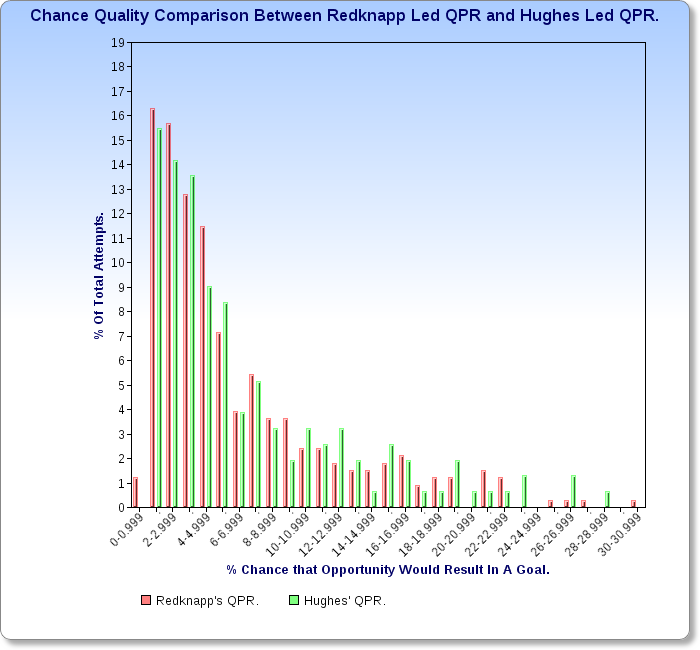
By contrast, Mark Hughes' previous employers, QPR were frequent purchasers of a lottery ticket. While Stoke and the vast majority of QPR's opponents were attempting to craft or bludgeon their way closer to goal, Rangers were content to expend 78 long range, low goal outcome attempts in scoring just once. It is perhaps unfair to attribute all of QPR's optimistic shooting tendencies to Hughes. He merely install the club at the foot of the table, it was left to Harry Redknapp to complete the transition from Premiership to Championship. However, as the plot below appears to illustrate, very little changed with the changing managerial identity.


Dicing the sample causes a few minor peaks and troughs to appear, but essentially the fondness for lots of low quality shots so characteristic of QPR's last season in the top flight appears to have been a tactical characteristic that was approved by both Hughes and Redknapp.

By contrast and in particular when viewed alongside QPR's overall shots allowed and attempted profile here,
a Stoke led by Tony Pulis actively drove their opponents to attempt QPR-like longshots, while keeping the quality chances for themselves.


The frequency with which Stoke's opponents felt compelled to shoot from distance in the final season of full-bloodied Pulisball stands out starkly in the left hand side of the plot. The Potters then inexorably out created their opponents in the richer areas of the penalty area, where the generic chance of a goal reached out to 16% and beyond. The Stoke fans could comfortably encourage their opponents to shot often from distance, safe in the knowledge that Lowton's late season screamer for Aston Villa in 2012/13 was the exception rather than the rule.


Inevitably, the comparisons between the approach of Stoke's current and previous manager has centred around the difference in passing styles. Although, so extreme was Pulis' adherence to the longball both in an attacking way and also as a way of relieving defensive pressure, that virtually any replacement would have appeared to be a move towards more Barca-like values.

However, as the final plot illustrates, a much more fundamental difference exists between the records of each man. With a similar calibre of side, Hughes persevered, unsuccessfully with low goal probability, long-range shots. Over half of the attempts made by QPR under his half season, relegation reign had a less than 5% chance of producing a goal.

By contrast, the much maligned Pulis in his gloriously annoying pomp offered up to the fans over 30% of their side's chances with a 15% or greater chance of scoring attached. All done with an eye still firmly fixed on goal prevention at the other end.

Sacrificing defensive stability for more frequent, lower quality chances and slightly more goals, may result in Stoke gaining promotion under Pulis and slipping back into the Championship under his more illustrious countryman. Superficially, Stoke appear to be joining the mainstream, but they may simply be trialing another, possibly less successful, if more visually appealing, niche market, where long balls are replaced by long shots.